WARBIRDS RESOURCE GROUP > VIETNAM > IROQUOIS > PREVIOUS PAGE
Design & Development
XH-40 and YH-40
The first Bell helicopter to use a turbine engine was a modified Model 47 (designated the XH-13F), first flown in October 1954. In 1955, anxious to obtain a powerful medical evacuation helicopter, the U.S. Army awarded Bell a contract to develop the next generation turbine-powered helicopter, designated the XH-40 (Bell company designation was the Model 204). The first XH-40 flew on 22 October 1956. Two more prototypes were built in 1957, and six YH-40 prototypes were tested in 1958.
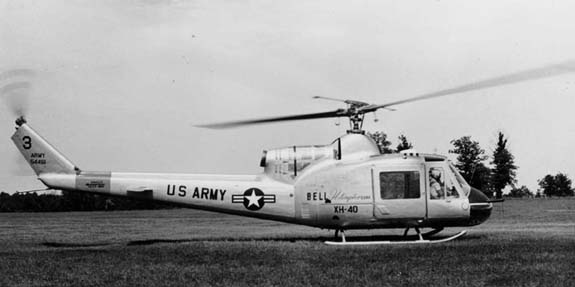
Bell XH-40 prototype. (Source: U.S. Army)
UH-1A
The HU-1A (later redesignated the UH-1A) was the first turbine-equipped U.S. helicopter to go into production, and production models first entered service with the 101st Airborne Division at Fort Lewis, Washington, the 82nd Airborne Division and the 57th Medical Detachment. Although they were intended for evaluation only, the Army quickly pressed them into operational service and Hueys with the 57th Medical Detachment arrived in Vietnam in March 1962.
The helicopter was originally designated the HU-1A, which is where it received its nickname - "Huey." The official U.S. Army designation Iroquois (Army helicopters are traditionally given Native American names) was almost never used in practice.
Fourteen of the original order of UH-1As were designated as TH-1A which were used for crew training and a single aircraft was redesignated XH-1A for grenade launcher testing in 1960.
The first UH-1As to arrive in Vietnam after the 57th Medical Detachment were with a new test unit, the US Army's Utility Tactical Transport Company (UTTCO). UTTCO had 20 "Alpha" Hueys and deployed to Vietnam in the fall of 1962. These aircraft were used as armed escorts to the existing H-21 Shawnees and H-34 Choctaws troop carriers.
In use the UH-1A proved under-powered with their Lycoming T53-L-1 powerplants of just 860 shp and indicated the need for improved follow-on models of the Huey.
UH-1B
The HU-1B was an improved model that was equipped with the Lycoming T53-L-5 engine of 960 shp, revised main rotor blades of 44 foot diameter and 21 inch chord, 13 inch higher rotor mast and a longer cabin that could accommodate seven passengers. This version was redesignated UH-1B in 1962.
Later production UH-1Bs were equipped with Lycoming T53-L-9 and L-11 engines of 1100 shp. Gross weight was 8,500 lbs and the standard empty weight was 4513 lbs.
Army testing of the "B" model started in November, 1960 with first production aircraft arriving in March, 1961. A total of 1010 "Bravo" models were delivered to the US Army. First deployment was in November 1963 when eleven were sent to Vietnam to join the "Alpha" models already in use by UTTCO.
One NUH-1B was produced for test purposes.
Bell certified a civil version of the UH-1B incorporating some minor safety improvements, such as improved door locks. The aircraft was marketed as the Bell 204B.
UH-1C The UH-1C was specifically developed as a gunship version until the "interim" attack helicopter, the Bell AH-1G Huey Cobra was available and to correct the deficiencies of the UH-1B when it was used in the armed role. The UH-1C was widely referred to as the "Huey Hog" in US Army service.
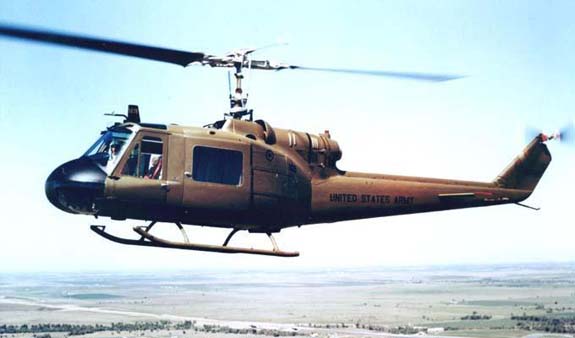
U.S. Army UH-1C "Huey". (Source: Unknown)
Development on the "C" model had commenced in 1960, with production starting in June 1966. A total of 766 "C" models was completed, including five for the Royal Australian Navy, designated N9 and five for Norway. The balance went to the US Army.
Many UH-1Cs were later re-engined with the 1400 shp Lycoming T53-L-13 powerplant. With this engine they were redesignated UH-1M.
UH-1D
The earlier "short-body" Hueys were a success, especially in the gunship role, but lacked the cabin space to be an effective troop transport. The US Army wanted a version that could carry a crew of four (two pilots and two door gunners) and also deliver an infantry section of eight-ten soldiers. Bell's solution was to stretch the UH-1B fuselage by 41 inches (105 cm) and use the extra space to fit two sideways-facing seats on either side of the transmission. This brought the total seating capacity to 15, including crew seats.
The new Huey was designated UH-1D by the US Army and as the Model 205 by Bell. The enlarged cabin could also accommodate six stretchers, double that of the earlier models, making the "Delta" a good MEDEVAC aircraft. In place of the earlier model's sliding side doors with a single window, larger doors were fitted which had two windows, plus a small "hinged panel" with an optional window, providing access to the cabin. The doors and hinged panels were quickly removable and the Huey could be flown in that configuration.
The first YUH-1D prototype flew in August 1960. Seven YUH-1Ds were delivered and tested at Edwards AFB starting in March 1961. The YUH-1D was initially equipped with a 44 ft main rotor and a Lycoming T53-L-9 engine. Testing revealed that more power was required and so the rotor was lengthened to 48 ft with a chord of 21 inches and the engine was upgraded to the Lycoming T53-L-11 engine of 1,100 shp. A longer tailboom was designed to accommodate the longer rotor blades. Gross weight was 9,500 lbs. Later production "Deltas" had the Lycoming T53-L-13 powerplant of 1,400 shp installed.
The first Army unit deliveries of the "Delta" model were on 9 August 1963 when the 11th Air Assault Division (Test) at Fort Benning Georgia received two. This unit was renamed the 1st Cavalry Division and deployed to Vietnam with its "Delta" Hueys.
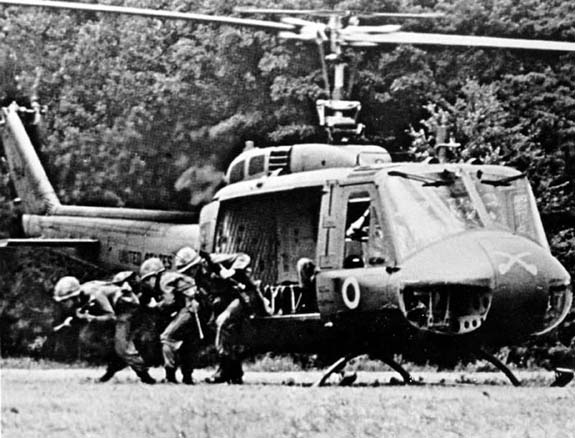
U.S. Army UH-1D offloading troops. (Source: U.S. Army)
The HH-1D was a base rescue/fire-fighting version for the US Army that had a 50 gallon water and foam spray system that could be discharged via an extendable 16 foot boom.
Upgrading the UH-1D to the Lycoming T53-L-13 engine, plus relocating the pitot tube from the nose to the roof resulted in a new model, the UH-1H, which was to become the most produced variant of the Huey family.
UH-1E
In 1962 the US Marines held a competition to choose a new assault support helicopter to replace the Cessna O-1 and Kaman OH-43D helicopter. The winner was the UH-1B which was already then in service with the US Army.
The UH-1B was developed into a special model, designated UH-1E, to meet Marine Corps requirements. The major changes included the use of all-aluminum construction for corrosion resistance (earlier UH-1s had some magnesium components), special avionics that were compatible with Marine Corps ground frequencies, a rotor brake to stop the rotor quickly on shutdown for shipboard use and a roof-mounted rescue hoist.
The UH-1E was first flown on 7 October 1963 and deliveries commenced 21 February 1964, with 192 aircraft completed. Due to production line realities at Bell the UH-1E was produced in two different versions, both with the same UH-1E designation. The first 34 built were essentially UH-1B airframes with the Lycoming T53-L-11 of 1,100 shp. Because Bell was switching Army production to the UH-1C the UH-1E production line was converted to commonality with the “C”. This meant the later “Echo” Hueys were completed with the “Charlie” style tailboom including the larger fin, the 540 rotor system and a gross weight of 8,500 lbs.
The Marines used the UH-1E as both a gunship and troop transport. Many were upgraded to the Lycoming T53-L-13 engine which produced 1,400 shp, making these “Echos” similar to the Army “Mike” models. At least 126 UH-1Es survived their Vietnam service and were still in use more than a decade later.
There was a Marine Corps training version of the UH-1E, which was based on the UH-1C variant and was designated TH-1E. Twenty were delivered in 1965.
UH-1F
Bell Helicopters was the winner of a 1963 United States Air Force competition for a support helicopter for use on its missile bases.
Bell had proposed the UH-1B for the competition but the USAF asked Bell to develop a special version of the "Bravo" in using the General Electric T58 turboshaft as a powerplant. The USAF already had a large inventory of these engines for its fleet of Sikorsky HH-3 Jolly Green Giant rescue helicopters and wanted to have commonality between the types. This engine was capable of 1,250 hp (932 kW) compared to the UH-1B's 1,100 hp (820 kW) Lycoming T53-L11.
In response Bell proposed an upgraded version of the UH-1B with the T58 engine installed. The resulting UH-1F had the shorter cabin of the "Bravo" Huey, but with the longer tail boom, rotor and transmission of the UH-1D.
Due to the Huey's configuration, Bell installed the T58 engine backwards compared to the HH-3. The Huey's engine is behind the transmission, whereas the HH-3's engines are in front of the transmission. Externally, the only visible differences from UH-1B were the engine exhaust, which exited to the right side of the engine and the longer tail boom.
The UH-1F was introduced into the USAF inventory on 20 February 1964. The USAF took delivery of 119 with production ending in 1967. Many of the aircraft served in southeast Asia with the 20th Special Operations Squadron and some were converted to the armed UH-1P configuration.
In Italy, Agusta produced a similar model by re-engining the 204B with the 1,225 hp (914 kW) Rolls-Royce Gnome turboshaft and later the UH-1F's General Electric engine. The Italian version was exported to the military of the Netherlands, Denmark, Austria, and Switzerland. It had a rescue hoist located at the right side of the cabin.
The last UH-1F was retired from the USAF in the early 1980s when it was replaced by the UH-1N. many of these aircraft later served as forest fire fighting aircraft with various US state governments and agencies.
There was a TH-1F trainer also built for the USAF. The first TH-1F was flown in January 1967 and deliveries ran from April to July of that year with 27 completed.
UH-1H
The UH-1H was an improved UH-1D, with the Lycoming T53-L-13 engine of 1,400 shp installed, plus the pitot tube relocated from the nose to the roof, to reduce ground damage to it. "Hotel" models were created by upgrading "Deltas" as well as new production. The first YUH-1H flew in 1966 with deliveries of production models starting in September 1967.
The "Hotel" model Huey was produced in larger numbers than any other model, with 4,850 delivered to the US Army alone. The "Hotel" model was widely exported and was also built under licence in Germany, Italy, Japan and Taiwan.
Ten were sold to Canada for use under the designation CUH-1H with the first one was delivered on 6 March 1968. These were evaluated by the Canadian Forces and found unsuitable for Canadian tactical use, which resulted in the Canadian government sponsoring the development of the twin-engined version of the "Hotel", the UH-1N Twin Huey. The ten CUH-1Hs were re-equipped for search and rescue use, redesignated CH-118 and served until 1995.
The "Hotel" model Huey was also the basis for a number of sub-variants:
– HH-1H was a UH-1H equipped for base rescue duties. Thirty were delivered to the
USAF between 1970-73.
– EH-1H was a UH-1H modified under Project Quick Fix in 1976 and used as
communications jamming aircraft with the US Army. Twenty-two aircraft
were modified to this configuration beginning in 1976. Initial aircraft
were fielded to the 82nd Airborne Division and the 2nd Armored Division.
The 82nd fielded the type during the invasion of Grenada (Operation Urgent Fury)
in 1983.
– EH-1X was an improved EH-1H communications jammer and DF aircraft.
– JUH-1 was a UH-1H equipped with retractable skid gear and an AN/APS 94 radar
boom mounted on the belly.
– UH-1V was a MEDEVAC version of the "Hotel", with upgraded avionics.
– TH-1H: Modified UH-1Hs for use as basic helicopter flight trainers by the USAF.
Bell developed a certified version of the UH-1H for the civil market. The aircraft incorporated minor changes for safety, such as dual sliding door locks and a baggage compartment in the tailboom. It was marketed by Bell as the Model 205A and later the improved 205A-1.
HH-1K
Bell was awarded a contract by the US Navy in December 1968 for a new search and rescue helicopter. The aircraft was designated the HH-1K and was basically a UH-1E with different avionics and the Lycoming T53-L-13 powerplant of 1,400 shp.
Deliveries of the “Kilo” Huey started in May 1970 and by November of that year three had been sent to Vietnam to serve with US Navy squadron HA(L)-3. A total of 27 HH-1Ks were produced.
UH-1L
With deliveries of the UH-1E underway to the US Marines the US Navy tested a few and found that the type would suit their uses as a utility helicopter. On 16 May 1968, the US Navy ordered eight aircraft under the designation UH-1L.
The “Lima” Huey was basically a UH-1E, of the later production type based on the Army's UH-1C, equipped with a rescue hoist and intake particle screen. The “Ls” were delivered without the armour or armament installed and were equipped with the Lycoming T53-L-13 powerplant of 1,400 shp.
The first four “Limas” were delivered in November 1969 and sent to Vietnam to equip the US Navy HA(L)-3 detachment assigned to Operation Sealords. In Vietnam the aircraft were modified with weapons and armour and were fitted to carry 500 lb bombs and 500 lb Fuel-Air Explosive munitions.
There was a TH-1L version of the UH-1L for the Navy to replace the H-34 and the borrowed Army UH-1Ds used in the training role, including for pilot aircraft carrier qualification training. Forty-five TH-1Ls were delivered starting in November 1969.
UH-1M
The "Mike" model Huey was a conversion of the existing UH-1C by re-engining it with the 1,400 shp Lycoming T53-L-13 powerplant used in the UH-1H. This provided more power to the "C" model for its role as a gunship and also provided engine commonality between the attack and transport helicopters in use in Vietnam at that time.
UH-1N
Bell flew the first twin-engined Huey in April 1965, calling it the Model 208. It was powered by two Continental Motors engines. The Canadian government provided the incentive for Bell to continue development of the Twin Huey using Pratt & Whitney Canada PT6 engines. The project attracted orders from the Canadian Forces, US Marine Corps, US Navy and USAF, but not the US Army.
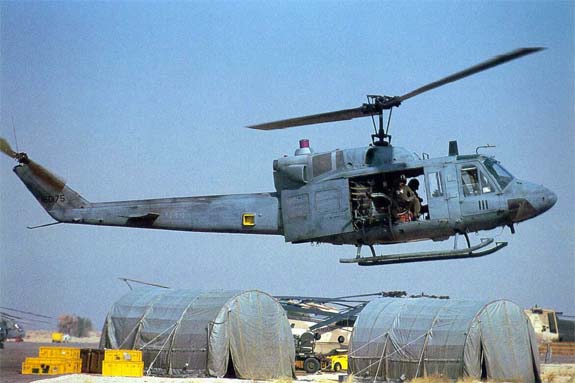
U.S. Marine Corps UH-1N. (Source: Unknown)
The UH-1N was widely produced and exported to a large number of countries and licence-built by Agusta in Italy and the People's Republic of China. Bell certified a civil version as the Model 212 in October 1970.
UH-1P
An unknown number of UH-1Fs were modified to UH-1P configuration by the USAF for use by the their 20th Special Operations Squadron, The Green Hornets, based in southeast Asia during the Vietnam War.
Official USAF sources state that these aircraft were used for a classified psychological warfare role, but this is incorrect. The "Papa" Hueys were in fact modified and employed as gunships armed with machine guns and rocket launchers.
UH-1V
The UH-1V is a version of the UH-1H converted by the US Army Electronics Command for MEDEVAC use. The aircraft have several upgrades including a radar altimeter, DME, ILS and a rescue hoist. The first aircraft were supplied to the New Hampshire National Guard.
EH-1X
The EH-1X was an improved EH-1H that was equipped with the AN/ALQ-151 system and configured for the airborne jamming, radio intercept and DF role. Ten EH-1Xs were built starting in late 1976 under Project Quick Fix IIA.
UH-1Y
The UH-1Y Venom is an upgraded UH-1N Twin Huey for the US Marines that was first flown on November 18 2006.
JUH-1 SOTAS
The JUH-1 was a modified UH-1H an AN/APS 94 radar system mounted in a rotating boom on the belly, where the cargo hook had been. The aircraft's skid landing gear was modified to retract allowing the radar antennae to rotate while in flight. The JUH-1s also incorporated an autopilot and improved navigation avionics. The radar system was connected by datalink to a ground station for analysis of the radar images.
At least four UH-1Hs were modified to JUH-1s for use by the US Army in Europe and Korea for use as technology demonstrators in the Stand Off Target Acquisition System (SOTAS) program. They were first deployed in 1975 but by 1986 they had been replaced by the EH-60 Black Hawk.
Sources:
Wikipedia: UH-1 Iroquois "Huey"
WARBIRDS RESOURCE GROUP > VIETNAM > IROQUOIS > PREVIOUS PAGE