WARBIRDS RESOURCE GROUP > VIETNAM > F-101 VOODOO > PREVIOUS PAGE
Operational History
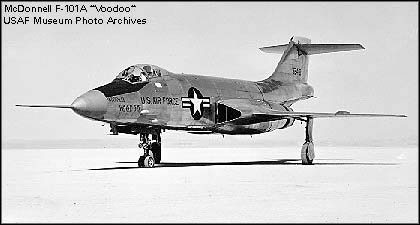
Despite SAC's loss of interest, the aircraft attracted the attention of Tactical Air Command, and the F-101 was reconfigured as a fighter bomber, intended to carry a single nuclear weapon for use against battlefield targets such as airfields. With the support of TAC, testing was resumed, with Category II flight tests beginning in early 1955. A number of problems were identified during development, with many of these fixed. The aircraft had a dangerous tendency toward severe pitch-up at high angle of attack that was never entirely solved. Around 2,300 improvements were made to the aircraft in 1955-56 before full production was resumed in November 1956.
The F-101 set a number of speed records, including: a JF-101A setting a world speed record of 1,942 km/h (1,207 mph) on 12 December 1957, handily beating the previous record set by the Fairey Delta 2. On 27 November 1957 during "Operation Sun Run," an RF-101C set the Los Angeles-New York-Los Angeles record in 6 hours, 46 minutes, the New York to Los Angeles record in 3 hours, 36 minutes, and the Los Angeles to New York record in 3 hours, 7 minutes. An F-101A flew from Carswell, Texas to Bermuda without refueling.
A total of 77 F-101As were built. They were gradually withdrawn from service starting in 1966. Twenty-nine survivors were converted to RF-101G specifications with a modified nose, housing reconnaissance cameras in place of cannons and radar. These served with the Air National Guard through 1972.
RF-101A
In October 1953, the USAF requested that two F-101As be built as prototype YRF-101A tactical reconnaissance aircraft. These were followed by 35 RF-101A production aircraft. The RF-101A shared the airframe of the F-101A, including its 6.33 g (62 m/s²) limit, but replaced the radar and cannons with up to six cameras in the reshaped nose. It was unusual in having provision for both flying boom and probe-and-drogue in-flight refueling capability. It entered service in May 1957, replacing the RB-57 Canberra.
USAF RF-101As from the 363d Tactical Reconnaissance Wing flew reconnaissance sorties over Cuba during the Cuban Missile Crisis in October 1962.
In October 1959 eight RF-101As were transferred to Taiwan, which used them for overflights of the Chinese mainland. Two were reportedly shot down.
F-101B/CF-101B/EF-101B
In the late 1940s, the Air Force had started a research project into future interceptor aircraft that eventually settled on an advanced specification known as the 1954 interceptor. Contracts for this specification eventually resulted in the selection of the F-102, but by 1952 it was becoming clear that none of the parts of the specification other than the airframe would be ready by 1954; the engines, weapons and fire control systems were all going to take too long to get into service. An effort was then started to quickly produce an interim supersonic design to replace the various subsonic interceptors then in service, and the F-101 airframe was selected as a starting point.
Although McDonnell proposed the designation F-109 for the new aircraft (which was to be a substantial departure from the basic Voodoo), the USAF assigned the designation F-101B. The Voodoo featured a modified cockpit to carry a crew of two, with a larger and more rounded forward fuselage to hold a Hughes MG-13 fire control radar. It had transponders linking it to the Semi-Automatic Ground Environment (SAGE) system, allowing ground controllers to steer the plane towards its targets by making adjustments through the plane's autopilot. The F-101B had more powerful P & W J57-P-55 engines, making it the only Voodoo not using the -13 engines. The new engines featured a substantially longer afterburner than J57-P-13s. To avoid a major redesign, the extended afterburners were simply allowed to extend out of the fuselage by almost 8 ft (2.4 m). The more powerful engines and aerodynamic refinements allowed an increased speed of Mach 1.75
The F-101B had no cannons; instead, it carried four Falcon air-to-air missiles, arranged two apiece on a rotating pallet in the fuselage weapons bay. The initial load was two GAR-1 (AIM-4A) semi-active radar homing and two GAR-2 (AIM-4D) infrared-guided weapons with one of each carried on each side of the rotating pallet. After the first two missiles were fired, the door turned over to expose the second pair. Standard practice was to fire the weapons in SARH/IR pairs to increase the likelihood of a hit. Late-production models had provision for two 1.7-kiloton MB-1/AIR-2 Genie nuclear rockets in place of two of the Falcons, and Project "Kitty Car" upgraded most earlier F-101Bs to this standard beginning in 1961.
From 1961 through 1966, F-101Bs were upgraded under Project 'Bright Horizon,' fitting them with an infrared sighting and tracking (IRST) system in the nose in place of the standard in-flight refueling probe.
The F-101B was made in greater numbers than the F-101A with a total of 479 being delivered by the end of production in 1961. Most of these were delivered to the Air Defense Command (ADC) beginning in January 1959. The only foreign customer for the F-101B was Canada. For more details on the history of the Voodoo in Canada, see CF-101 Voodoo.
The F-101B was withdrawn from ADC service from 1969 to 1972. Surviving USAF aircraft were transferred to the Air National Guard, where they served until 1982.
TF-101B/F-101F/CF-101F
Some of the F-101Bs were completed as dual-control operational trainer aircraft initially dubbed TF-101B, but later redesignated F-101F. Seventy-nine new-build F-101Fs were manufactured, and 152 more existing aircraft were later modified with dual controls. Ten of these were supplied to Canada under the designation CF-101F. These were later replaced with 10 updated aircraft in 1971.
RF-101B
In the early 1970s, a batch of 22 ex-RCAF CF-101Bs were returned to the USAF and converted to RF-101B reconnaissance aircraft with their radar and weapons bay replaced with a package of three KS-87B cameras and two AXQ-2 TV cameras. An in-flight refueling boom receptacle was fitted. These aircraft served with the 192nd Tactical Reconnaissance Squadron of the ANG through 1975. They were expensive to operate and maintain and had a short service life.
F-101C/RF-101H
The F-101A fighter-bomber had been accepted into Tactical Air Command service despite a number of problems. Among others, its airframe had proven to be capable of withstanding only 6.33-g (62 m/s²) maneuvers, rather than the intended 7.33 g (72 m/s²). An improved model, the F-101C, was introduced in 1957. It had a 500 lb (227 kg) heavier structure to allow 7.33-g maneuvers as well as a revised fuel system to increase the maximum flight time in afterburner. There were no external differences between F-101A and F-101C other than the serial numbers. Forty-seven were produced.
Originally serving with the 27th Tactical Fighter Wing at Bergstrom AFB in Texas, the aircraft were transferred in 1958 to the 81st Tactical Fighter Wing which operated three squadrons from the twin RAF air stations Bentwaters & Woodbridge. The 78th Tactical Fighter Squadron was stationed at Woodbridge, while the 91st and 92nd were stationed at Bentwaters. The 81st TFW served as a strategic nuclear deterrent force, the Voodoo's long range putting almost all of the Warsaw Pact countries, and targets up to 500 miles deep into the Soviet Union within reach.
Both the A and C model aircraft were assigned to the 81st TFW, and were used interchangeably within the three squadrons. Operational F-101A/C were upgraded in service with Low Angle Drogued Delivery (LADD) and Low Altitude Bombing System (LABS) equipment for its primary mission of delivering nuclear weapons at extremely low altitudes. Pilots were trained for high speed, low level missions into Soviet or East Block territory, with primary targets being airfields. Although these were not discussed as one-way missions, it was assumed by all involved that chances of the pilots returning after delivering their weapons was nil.
The F-101C never saw combat and was replaced in 1966 with the F-4C Phantom II. Thirty-two aircraft were later converted for unarmed reconnaissance use under the RF-101H designation. They served with Air National Guard units until 1972.
RF-101C
Using the reinforced airframe of the F-101C, the RF-101C first flew on 12 July 1957, entering service in 1958. Like the RF-101A, the RF-101C had six cameras in place of radar and cannons in the reshaped nose. Unlike the RF-101A, the RF-101C retained the ability to carry a single nuclear weapon on the centerline pylon. One hundred and sixty-six RF-101Cs were built, including 96 originally scheduled to be F-101C fighter-bombers.
The 1964 Project "Toy Tiger" fitted some RF-101C with a new camera package and a centerline pod for photo-flash cartridges. Some were further upgraded under the Mod 1181 program with automatic control for the cameras.
The RF-101C saw service during the Cuban Missile Crisis and was sent to Vietnam in 1961, becoming the first USAF jet aircraft to serve there. RF-101C saw heavy service during the Vietnam War, with the first F-101 being lost in November 1964 to ground fire. From 1965 through November 1970, its role was gradually taken over by the RF-4C Phantom II. In some 35,000 sorties, 44 aircraft were lost: 31 to anti-aircraft fire, five to SAMs, one to an airfield attack, six to operational accidents, and one in air combat to a MiG-21 in September 1967. The RF-101C's speed made it largely immune to MiG interception. In April 1967, ALQ-71 ECM pods were fitted to provide some protection against SAMs. Although the Voodoo was again able to operate at medium altitudes, the added drag decreased the speed enough to make RF-101 vulnerable to MiGs and thus requiring fighter escort.
On 27 November 1957 during Operation Sun Run an RF-101C set the Los Angeles-New York-Los Angeles record in 6 hours, 46 minutes, the New York to Los Angeles record in 3 hours, 36 minutes, and the Los Angeles to New York record in 3 hours, 7 minutes.
After withdrawal from Vietnam, the RF-101C continued to serve with USAF units through 1979.
In service, the RF-101C was nicknamed "Long Bird;" it was the only Voodoo to see combat.
Sources:
Wikipedia: F-101 Voodoo
WARBIRDS RESOURCE GROUP > VIETNAM > F-101 VOODOO > PREVIOUS PAGE